Explosives Unit
Byers K9 Services
Nationwide Explosive Detection K9 Services
A trained explosive detection dog is still the fastest and most mobile way to clear a large space for explosive odor. Byers K9 Services deploys handler-and-K9 teams nationwide to sweep venues, campuses, office buildings, vehicles and freight before people walk in — and to respond when a threat has already been called in.
The Unwanted Truth
Metal detectors and bag checks find objects. They do not find odor. An explosive detection K9 works the air, moves through a crowd or a parking structure at walking speed, and covers ground that fixed screening equipment can’t reach. With explosives there is usually only one chance to get it right — which is why we train year-round, document every session, and hold our teams to published national standards instead of our own marketing.
Source: ATF / U.S. Bomb Data Center, 2024 Explosives Incident Report.
What Our Explosive Detection K9s Are Trained to Find
Explosive detection K9s are trained on odor groups, not on brand-name products. The national guideline for explosives detection canines — SWGDOG SC8, now published as ANSI/ASB Standard 092 — requires a team to reliably detect these six mandatory groups at minimum.
Nitroglycerin-Based
Dynamite and commercial blasting products built on a nitroglycerin base.
TNT & Nitroaromatics
Military and commercial charges in this family, including their manufacturing by-products.
RDX-Based
The base for C-4 and most plastic and sheet explosives.
PETN-Based
Detonating cord, sheet explosive, and common initiator material.
Black Powder
Pipe-bomb and improvised-device filler, plus pyrotechnic material.
Smokeless Powder
Double-base smokeless propellants used in improvised devices.
Because a dog alerts on the odor signature rather than the finished device, a trained K9 will also indicate on residue, wrapping, storage containers, tools and components long after the material itself has been moved. That is the part screening equipment misses entirely.
Where Explosive Detection K9 Teams Are Deployed
Anywhere a large number of people and a large number of unscreened bags arrive in the same place at the same time.
Concerts, Festivals & Stadium Events
Full sweep before doors open, plus a team on standby through the event.
Schools, Colleges & Campuses
Scheduled building and locker sweeps and bomb-threat response. See our K9s For Students program.
Corporate Offices & High-Rises
Mail rooms, loading docks, lobbies, parking structures and executive floors.
Government & Public Facilities
Courthouses, municipal buildings and civic centers — recurring sweeps and event-driven screening.
Hotels, Conference Centers & Houses of Worship
Pre-function sweeps for conferences, banquets and services.
Warehousing, Freight & Vehicles
Inbound cargo, fleet vehicles and delivery inspection.
Executive Protection & VIP Advance
Route, vehicle and venue clearance ahead of arrival, alongside our patrol units.
Not sure where you fit? See the full list of industries we service.
How a Byers K9 Explosive Sweep Works
Scope and walk-through
We map the site first — choke points, mail rooms, HVAC and utility access, parking structures, stairwells — and set a search grid before the dog comes out of the vehicle. You get a plan, not a lap around the building.
Sequencing and area control
Zones are swept in order and then held. A cleared zone only stays cleared if access behind us is controlled, so we coordinate with your security staff — or supply our own guards.
The search
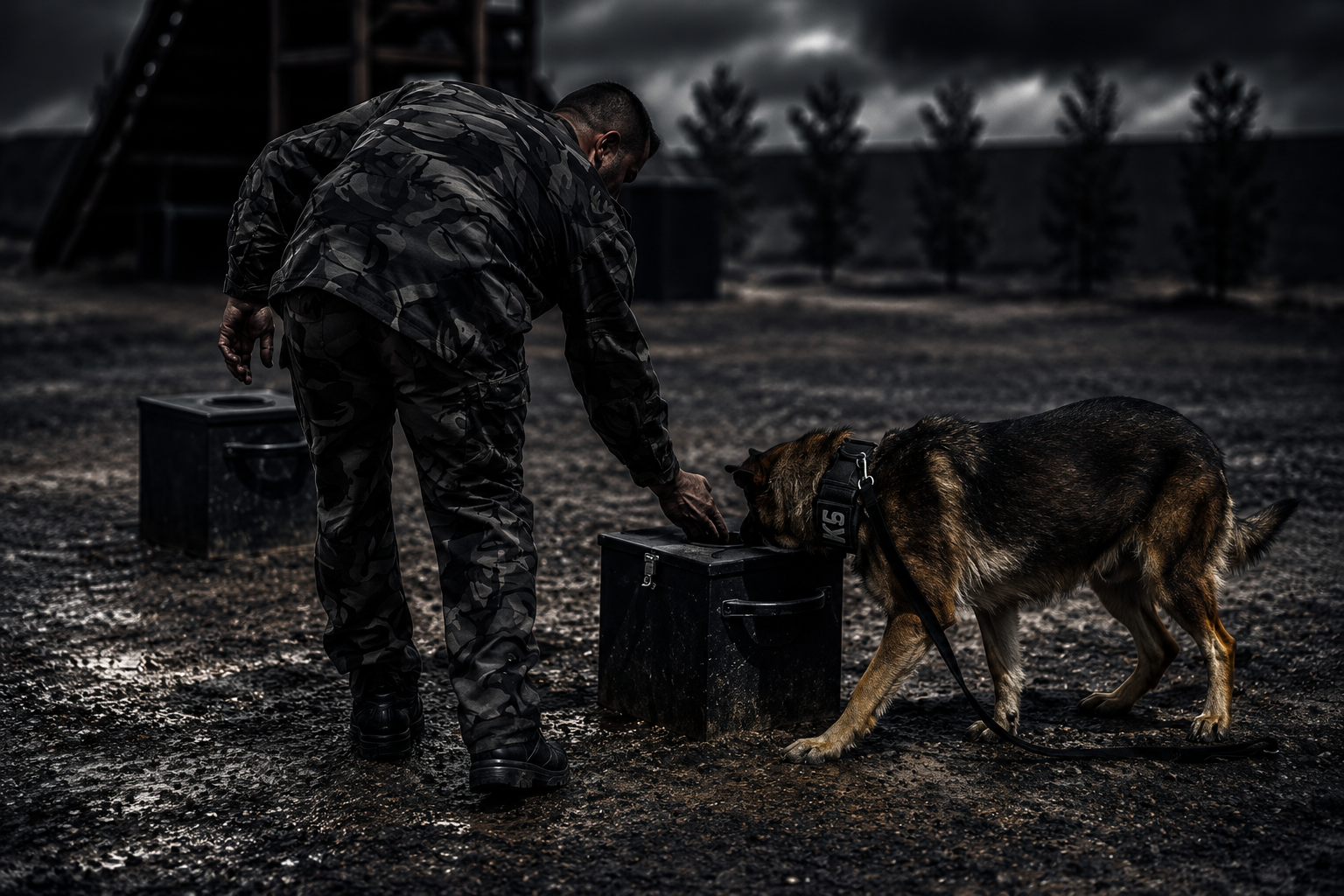
The handler works the K9 systematically through each zone, reading changes in the dog’s behavior and re-working any area of interest. Our dogs are trained to a passive alert: they sit or freeze on odor rather than scratching or digging at the source.
Alert protocol
Our teams never touch, move or disturb a suspected device. On an alert we withdraw, secure the perimeter, and hand off to local law enforcement and the bomb squad according to your emergency action plan. Detection is our job; render-safe is theirs.
Documentation
You receive a written sweep report — areas covered, times, team identification, alerts and how each was resolved. That record is what your insurer, district, or legal counsel will ask for later.
Training, Certification and Standards
Before you hire any explosive detection K9 vendor — us included — ask for three things:
1. Current certification
Which body certified the team (NNDDA, NAPWDA, NPCA, or a documented state or agency standard), the issue date, and the expiration. Explosive detection certifications are typically valid for one year.
2. Maintenance training records
Logged, ongoing training with varied aids, varied quantities, varied heights and depths of placement, and blind or double-blind trials. A certificate from two years ago tells you nothing about today.
3. Handler credentials and insurance
Who is on the other end of the leash, what their background is, and what coverage they carry on your site.
We hold our own teams to the same questions, and we provide documentation to every client on request.
Explosive Detection K9 FAQs
How long does an explosive detection K9 sweep take?
Can a K9 detect explosives sealed inside a vehicle or container?
What happens if the dog alerts?
How often do explosive detection K9 teams recertify?
Are the dogs safe around crowds, children and other animals?
What areas do you serve?
How much does an explosive detection K9 sweep cost?
Request an Explosive Detection K9 Team
Tell us the site, the date and the square footage, and we’ll tell you exactly what it takes to clear it.